7 Best Customer Engagement Platforms in 2026



Thursday, March 26, 2026


7 Best Customer Engagement Platforms in 2026


View the podcast on Youtube

Customer engagement isn’t a channel problem anymore. It’s a coordination problem.
Most companies already have the tools to talk to customers, whether it’s through email, chat, product analytics, or support systems. What they don’t have is a way to connect those interactions into something meaningful.
That’s where customer engagement tools come in.
The best platforms don’t just help you communicate. They help you understand what customers are saying, recognize patterns across interactions, and turn those patterns into actions your teams can actually execute.
This guide breaks down the top customer engagement platforms in 2026, what they’re best at, and how to choose the right one based on how your business actually operates.
What Is a Customer Engagement Platform?
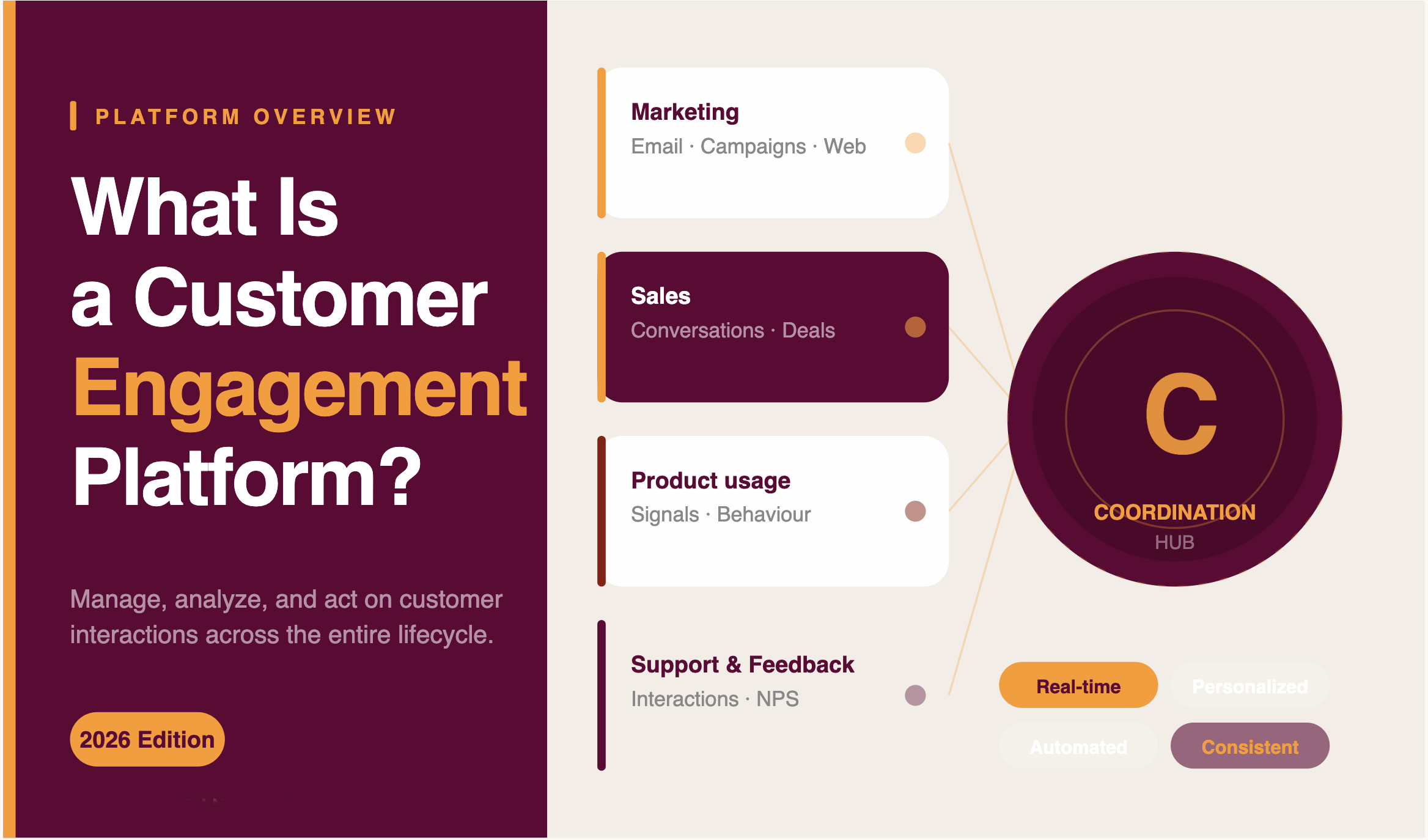
A customer engagement platform is a system that helps businesses manage, analyze, and act on customer interactions across the entire lifecycle.
That includes:
- Marketing touchpoints (email, campaigns, web)
- Sales conversations
- Product usage signals
- Support interactions
- Customer feedback
At a functional level, these platforms help teams:
- Deliver real-time support or assistance
- Monitor and analyze customer interactions across channels
- Automate customer-facing processes and responses to save time
- Create and track customer journey maps to improve the overall experience
- Send personalized messages and offers to specific segments of your audience
But the definition has evolved.
In 2026, client engagement software aren’t just systems of communication, but systems of coordination. They connect signals from across the customer journey and help teams respond in a way that’s consistent, timely, and relevant.
Why Customer Engagement Platforms Still Matter
Customer engagement doesn’t break because teams aren’t talking to customers.
It breaks because those interactions don’t connect to anything.
Messages get answered. Tickets get closed. Campaigns get sent. But the insight behind those interactions rarely makes it back into how the business operates.
That’s the gap customer engagement platforms are meant to solve.
As your business grows, so does the volume of:
- Conversations
- Product signals
- Feedback
- Critical customer moments
Without a system to connect them, teams operate on fragments. That leads to:
- Inconsistent experiences
- Missed opportunities
- Slow, reactive decisions
Modern platforms turn those interactions into something usable, so teams can respond with context, not guesswork.
What to Look For in a Customer Engagement Platform
Not all platforms are built the same. The difference usually comes down to how well they connect insight to action.
1. Unified Customer View
You shouldn’t have to piece together context from five different tools. The platform should bring together behavior, conversations, and feedback into one place.
2. Cross-Channel Engagement
Customers move between channels constantly. Your platform should make those transitions seamless.
3. Actionable Insights (Not Just Data)
Dashboards don’t drive decisions. Look for platforms that surface clear signals your team can act on without heavy analysis.
4. Workflow Automation
Engagement breaks down when everything is manual. Strong platforms help trigger the right actions at the right time.
5. Integration with Your Stack
Your consumer engagement tool should work with your CRM, support tools, and product data, not sit alongside them.
Best Customer Engagement Platforms in 2026
1. Deeto
Deeto is built around a simple idea: your best engagement strategy already exists inside your customers, you just need to operationalize it.
Instead of focusing only on messaging or automation, Deeto connects customer voice to real business actions. That includes references, advocacy, content, and feedback, all orchestrated in one system.
Why it stands out
- Customer voice → action: Transforms real customer feedback into structured, repeatable workflows—turning insights into references, content, and advocacy without manual coordination.
- Intelligent matching: Connects prospects with the most relevant customers based on real context, not static lists, ensuring interactions drive meaningful outcomes.
- Orchestrated engagement: Automates when and how clients are engaged across sales, marketing, product, and advocacy initiatives—not just isolated campaigns.
- Embedded into your workflow: Works where your teams already operate, syncing with CRMs and go-to-market tools so engagement is seamless and actionable.
- Real-time visibility: Surfaces trends in sentiment, engagement, and advocacy as they happen, helping teams respond proactively rather than reactively.
- Customer-led participation: Gives customers control over how they contribute—calls, quotes, or content—boosting engagement quality and willingness to participate.
- Built for trust: Designed with enterprise-grade privacy and compliance, including GDPR, CCPA, and SOC2, so your customer data is secure by default.
Best for: B2B teams that want to scale customer-led growth, not just communication.
2. HubSpot
HubSpot (which includes Marketing Hub, Sales Hub, Service Hub, and CMS Hub) is an all-in-one platform that facilitates the broad, standard functions of your customer engagement strategy, like email marketing and customer service ticketing.
Why it stands out
- Orchestrates the full customer journey, turning interactions into actionable workflows
- Adapts engagement in real time based on behavior and signals
- Aligns sales, marketing, and CRM data so teams act in unison
- Provides deep integrations and insights embedded directly into daily workflows
Best for: Teams that want a centralized system for marketing and sales engagement.
3. Intercom
Intercom is a customer engagement platform built for real-time, conversational support. It helps SaaS companies deliver fast, personalized interactions at scale, without losing context or quality. It’s a strong fit for teams focused on improving support and onboarding through direct, in-product communication.
Why it stands out
- Centralizes conversations across email, chat, in-app, and social channels
- Delivers personalized, real-time support with AI-assisted interactions
- Guides onboarding and in-product engagement to reduce friction and support volume
- Automates ticket routing and follow-ups for consistent workflows
- Surfaces real-time insights on customer behavior and support team performance
- Connects seamlessly with Slack, HubSpot, Shopify, Zendesk, and other tools
Best for: SaaS companies prioritizing product-led engagement and support.
4. Gainsight
Gainsight helps B2B SaaS teams reduce churn by turning customer signals into action. It monitors health scores, automates retention playbooks, and highlights risks before they become problems, making customer success proactive, not reactive.
Why it stands out
- Turns customer health signals into proactive retention actions
- Automates retention and expansion playbooks across the lifecycle
- Highlights churn and risk indicators before issues arise
- Aligns customer success, sales, and product teams around actionable insights
- Provides real-time analytics to track engagement and outcomes
Best for: Customer success teams focused on long-term relationships.
5. Zendesk
Zendesk helps teams manage high volumes of customer interactions efficiently, turning support tickets into streamlined workflows. It reduces response times, provides AI-assisted self-service, and ensures customers get the right answers quickly, making it ideal for support teams focused on consistency, scale, and quality.
Why it stands out
- Streamlines high-volume customer support into efficient, manageable workflows
- Reduces response times with AI-assisted self-service and live agent support
- Centralizes tickets and conversations across channels for full visibility
- Provides real-time insights on team performance and customer interactions
- Integrates seamlessly with CRM, collaboration, and analytics tools
Best for: Support teams that need scale and consistency.
6. Braze
Braze helps brands deliver personalized, real-time messaging across every digital touchpoint, turning customer interactions into coordinated, timely experiences. It enables teams to engage users with push notifications, in-app messages, and cross-channel campaigns, without manual work or tool-switching, so engagement drives measurable retention and growth.
Why it stands out
- Delivers personalized, behavior-driven campaigns across email, mobile, and web
- Adapts messaging in real time based on customer actions and preferences
- Orchestrates multi-channel journeys for consistent lifecycle engagement
- Provides analytics to optimize campaign performance continuously
- Integrates with CRM and analytics tools for seamless workflow execution
Best for: Companies focused on lifecycle marketing and personalization.
7. Sprout Social
Sprout Social helps teams manage and engage audiences across social media with clarity and impact. It centralizes customer interactions, tracks brand sentiment in real time, and provides tools for publishing, audience targeting, analytics, and team collaboration, so social engagement drives actionable insights and measurable business outcomes.
Why it stands out
- Centralizes social conversations across platforms for full visibility
- Tracks sentiment and engagement trends in real time
- Automates publishing and response workflows for efficiency
- Provides analytics to guide social strategy and performance decisions
- Integrates with CRM and marketing tools to connect social data to broader customer insights
Best for: Teams where social is a primary engagement channel.
How to Choose the Right Platform
Most teams don’t fail because they picked the “wrong” tool. They fail because the tool doesn’t match how they actually work.
Deeto is different. It’s built to connect every customer interaction into one coordinated system, turning insights into action across sales, marketing, product, and customer success. For teams that want to orchestrate engagement rather than manage silos, Deeto is the solution.
Other platforms can help with specific needs:
- Pipeline and marketing automation → HubSpot
- Real-time conversations → Intercom
- Retention and lifecycle management → Gainsight
- High-volume support operations → Zendesk
- Multi-channel campaigns → Braze
- Social engagement → Sprout Social
But if your goal is to orchestrate the full customer journey and activate insights across every team, Deeto is the platform that does it all.
Where Customer Engagement Is Headed
Customer expectations didn’t just increase, they changed.
People expect:
- Faster responses
- More relevant interactions
- Consistency across every touchpoint
But the real shift is internal.
The companies that are improving engagement aren’t just adding more tools. They’re getting better at connecting what customers say to what teams do next.
That’s the difference between activity and impact.
The Bottom Line
Customer engagement platforms are no longer just about communication. They’re about coordination.
The right platform helps you:
- See what’s actually happening across the customer journey
- Understand what matters
- Act on it, consistently
Because better engagement isn’t about reaching more customers.
It’s about responding to them better.
🎉 Save your spot
Register for the event
Once your spot is secured, we’ll send your confirmation details.
Subscribe to our newsletter
Subscribe to receive the latest blog posts to your inbox every week.
By subscribing, you agree to our Privacy Policy
Subscribe to our newsletter
Get the latest news and updates from our team.
By subscribing, you agree to our Privacy Policy
Related posts

Deeto vs Base AI: Which Platform Is Right for Your Team?

Deeto vs Base AI: two different bets on what customer voice is for. Here's how they compare across intelligence, advocac

Authentic voice, now for every decision.
Custom Briefs is here. AI Interviews on Deeto, now built for the decision in front of you. Just ask the AI Assistant.

12 Ways to Reduce Customer Churn and Keep More Customers
Learn how to reduce customer churn with 12 proven strategies covering early risk detection, value proof, and more.